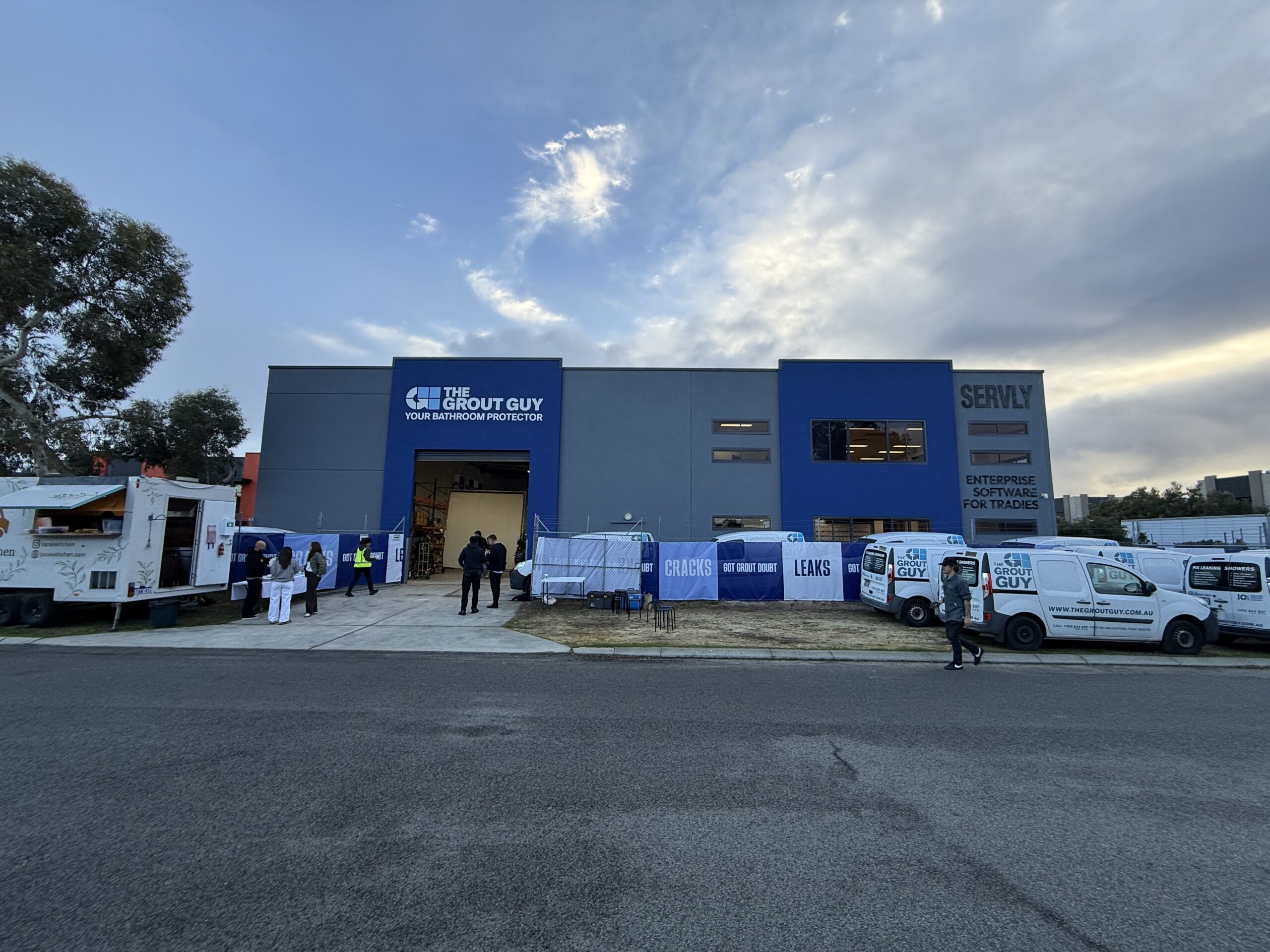
Salesforce recently filmed a campaign inside The Grout Guy’s offices. Not because The Grout Guy sells software, but because a national trade business had used Salesforce to build something Salesforce itself wanted to showcase: an increasingly agentic, AI-powered field service operation, built from the inside out by the people running it.
That platform is now called Servly, and it’s available to other trade and home services businesses facing the same growth problems The Grout Guy once had.
From one van to a Salesforce success story
The Grout Guy started as one van in Perth. It’s now Australia’s largest tile and grout restoration network, with more than 150 field technicians operating across five states and more than 50,000 jobs completed a year.
The technology evolved alongside the business at every stage. What began as a standard Salesforce implementation to manage leads and jobs became a deeply customised operating system, then a recognised Salesforce customer success story, then World Tour content, and now Servly: the same engine offered to other trade businesses.
Built by operators solving their own problem
Grout Guy founder Brad Young and CTO Anthony Messina didn’t set out to build a software company. Anthony puts it plainly: they were trying to figure out how to scale The Grout Guy without throwing more people at every operational problem.
Spreadsheets and manual dispatch worked when the business was small. As it expanded across Australia, those systems became a barrier: more leads meant more follow-up, more technicians meant more scheduling complexity, and more states meant more chances for information to fall between the cracks. Rather than keep adding administrative staff, Brad and Anthony rebuilt how the business ran, on Salesforce, with automation and AI layered in as the problems demanded it.
Only after solving it for themselves did they realise other trade businesses were stuck with exactly the same problems.
What Servly actually is
Servly isn’t software designed in isolation and sold into a market. The workflows, accelerators, AI agents and operating model behind it were all built and proven inside a real national field service business, solving real problems for real technicians, dispatchers and customers, not sketched out on a whiteboard.
Real AI agents, not a demo
Servly runs on a set of named AI agents already working inside a live national field service operation, not a proof of concept:
- Walter handles work-order processing
- Larry handles lead qualification
- Casie handles triage
- Groutie and Mason handle scheduling and rescheduling, including pre-work briefs
These agents process real leads, real quotes and real technician schedules every day across five states. That’s the difference between an AI feature on a slide and an AI agent doing the job.
Proven under real pressure
Years of operational learning inside a genuinely high-volume trade business produced results most software vendors can only claim in theory:
- Dispatcher capacity improved from roughly one dispatcher per four to seven technicians, to more than one per 25 technicians
- Quote turnaround dropped from 2–3 days to around 30 minutes
- More than 50,000 jobs are completed a year
- Quote conversion now sits around 50%
- The business continues to grow at around 40% year on year
The team behind Servly
Servly was co-founded by Brad Young and Anthony Messina, and is also part-owned by The Grout Guy staff: the schedulers, salespeople, customer service teams, managers, technicians and technology specialists who helped shape and prove the system through everyday use.
Sharing a hard-earned advantage
Many growing trade businesses face the problems The Grout Guy once faced: inconsistent follow-up, delayed quotes, overwhelmed schedulers, and systems that don’t talk to each other. Servly gives those businesses a way to install an operating model already proven inside one of Australia’s largest home services businesses, backed by the same Salesforce foundation and the same AI agents doing the work today.
The Grout Guy could have kept that advantage private. Instead, Brad and Anthony chose to share it.
If your business is fighting the same growth pains that once slowed The Grout Guy down, get in touch with the Servly team to see how the platform could work for you.